
Introduction
Many ERP projects begin with a feature checklist. Yet a checklist rarely explains why the business needs a new system, or how anyone will know it worked. As a result, companies end up with software that technically does everything but changes very little.
ERP solutions development services take a different route. They start with the problem, such as slow order fulfillment, poor traceability, or unclear project margins. Then they design an ERP solution around that problem, your industry, and the results you want.
In this guide, Elysian Intelligence Business Solution explains what solution-led ERP looks like, six proven industry use cases, how the work is delivered, and how to measure ROI. By the end, you’ll know how to brief a partner on outcomes, not just features.
What Are ERP Solutions Development Services?
ERP solutions development services are professional services that design, build, and deliver a complete ERP solution for a specific business and industry. They combine strategy, solution architecture, platform configuration, custom development, integration, and change management to achieve defined business outcomes.
At a glance: Software, service, and solution ERP software is the platform you license or build. ERP services are the individual tasks around it, such as development or data migration. An ERP solution is the finished result: software, services, data, and processes working together to solve a business problem.
Why the word “solution” matters
A solution is judged by results, not by deliverables. Therefore, a solution-led partner commits to targets such as faster month-end close or higher inventory accuracy, and designs everything to reach them.
How Is Solution-Led ERP Different From Feature-Led ERP?
Solution-led ERP starts with business outcomes and industry needs, then selects features to meet them. Feature-led ERP starts with a list of functions and hopes they add up to value. The solution-led approach usually produces less custom work and faster ROI.
| Aspect | Feature-Led ERP | Solution-Led ERP |
|---|---|---|
| Starting point | A list of required features | A business problem and target outcome |
| Requirements | Must have" functions from each department | Processes and KPIs that matter most |
| Industry focus | Generic | Built around sector rules and workflows |
| Custom development | Often heavy, to match every request | Targeted where it drives results |
| Success measure | Go-live on time | KPIs improved after go-live |
| Typical result | Wide system, mixed adoption | Focused system, measurable gains |
What Are the 6 Proven ERP Solution Use Cases?
The six most proven ERP solution use cases are manufacturing, wholesale distribution, retail and e-commerce, healthcare and life sciences, construction and field services, and professional services. Each industry has specific processes and compliance needs that shape the solution design.
| Industry | Core Challenge | Key Solution Elements | Typical Outcome |
|---|---|---|---|
| Manufacturing | Planning and quality | MRP, BOMs, shop-floor data, QC | Less downtime, lower scrap |
| Wholesale distribution | Stock and margins | Multi-warehouse, pricing rules, EDI | Higher fill rates, better margins |
| Retail and e-commerce | Omnichannel stock | POS and store integration, returns, demand planning | Fewer stockouts, faster fulfillment |
| Healthcare and life sciences | Compliance and traceability | Lot and serial tracking, audit trails, validation | Faster recalls, easier audits |
| Construction and field services | Job costing | Project costing, equipment, mobile apps | Accurate job margins, faster billing |
| Professional services | Utilization and billing | Time, resources, project accounting | Higher utilization, faster invoicing |
Manufacturing
Manufacturers need tight links between planning, inventory, and production. A strong solution connects MRP to shop-floor data, so planners see real capacity, not estimates.
Wholesale distribution
Distributors live on margin and availability. Therefore, the solution focuses on multi-warehouse stock, complex pricing, and automated supplier and customer EDI.
Retail and e-commerce
Retailers need one view of stock across stores and online channels. In addition, returns, promotions, and demand forecasting must work in real time.
Healthcare and life sciences
Regulated firms need lot tracking, electronic records, and validated processes. For example, US medical device makers must meet FDA 21 CFR Part 11 rules for electronic records.
Construction and field services
These firms need accurate job costing and mobile access. As a result, the solution links projects, equipment, subcontractors, and field apps.
Professional services
Consultancies and agencies need utilization, project margins, and fast invoicing. So, the solution centers on time, resources, and project accounting.
What Makes Up a Complete ERP Solution?
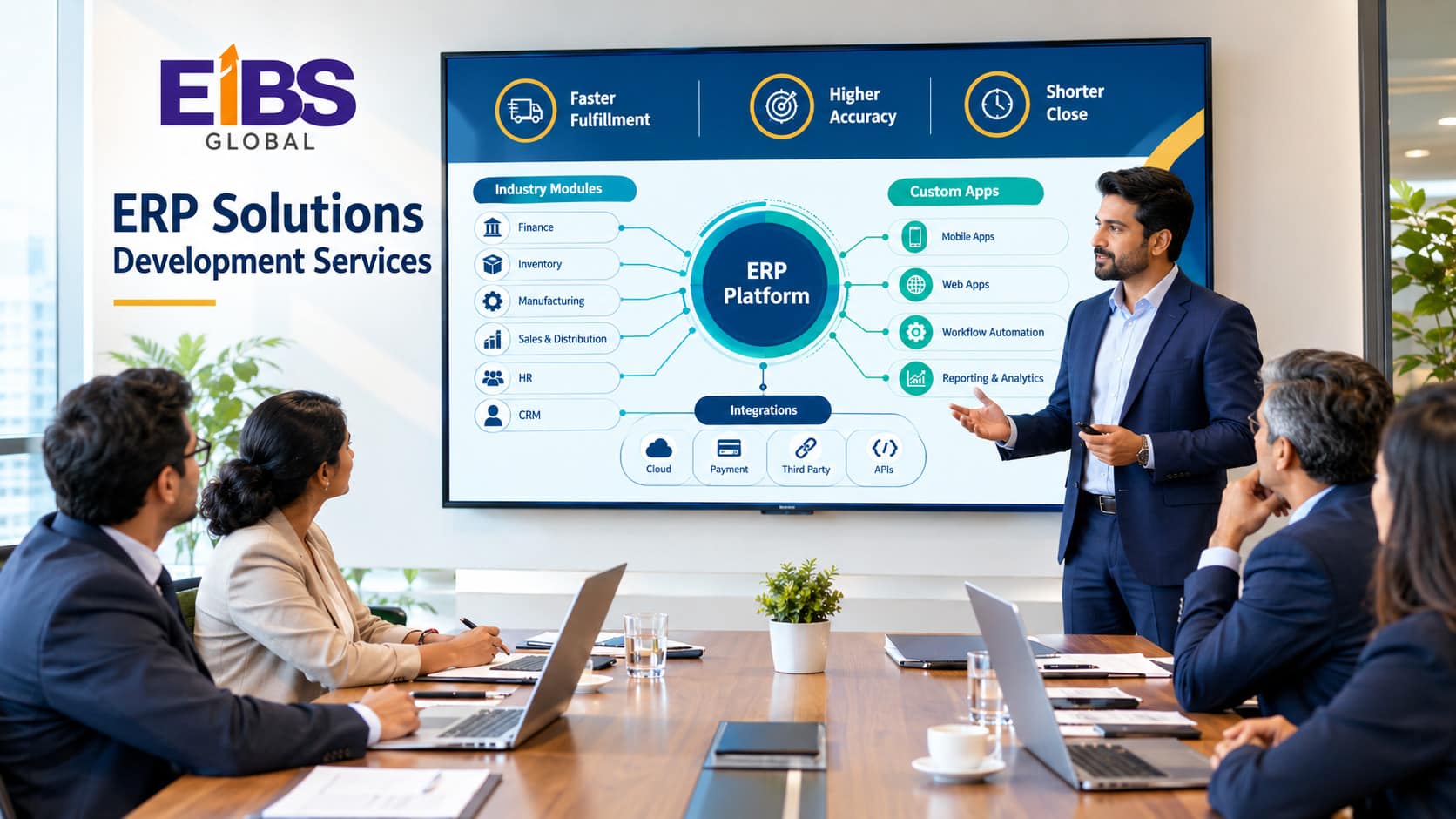
A complete ERP solution combines seven components: a core platform, industry modules, custom ERP solutions for unique processes, integrations, data and analytics, security and compliance controls, and change management. Leaving out any one of them weakens the result.
- Core platform: Finance, procurement, and inventory foundations.
- Industry modules: Ready-made functions for your sector.
- Custom ERP solutions: Targeted development for what makes you different.
- Integrations: Links to CRM, e-commerce, banking, IoT, and partners.
- Data and analytics: Clean master data, dashboards, and KPIs.
- Security and compliance: Roles, audit trails, and industry controls.
- Change management: Training, communication, and support for users.
Notably, the seventh component is the one most often underfunded. However, it’s frequently the one that decides whether the solution succeeds.
How Do ERP Solutions Development Services Work?
ERP solutions development services typically follow six phases: problem framing, solution design, platform and module selection, build and integration, rollout, and value tracking. Each phase links back to the business outcomes agreed at the start.
- Frame the problem. Define two or three business outcomes, such as “cut order-to-ship time by 30%.”
- Design the solution. Map future processes and create a solution blueprint covering platform, modules, apps, and data.
- Select the platform and accelerators. Choose the core ERP and any industry templates that shorten delivery.
- Build and integrate. Configure the platform, develop custom ERP solutions where needed, and connect other systems.
- Roll out in phases. Launch by site, department, or process, with role-based training.
- Track value. Compare KPIs to the baseline at 3, 6, and 12 months, then optimize.
At Elysian Intelligence Business Solution, for example, every solution blueprint lists its target KPIs on the first page. Consequently, design decisions are always checked against the results the client actually wants.
Why accelerators help
Industry accelerators are pre-built templates, such as standard workflows, reports, and data models for a sector. As a result, teams spend less time building common features and more time on what’s unique to your business.
How Do You Measure ERP Solution ROI?
You measure ERP solution ROI by setting baseline KPIs before the project, tracking them after go-live, and comparing the value gained with the total cost of the solution. Both hard savings and productivity gains should be included.
| KPI | What It Shows | Example Target |
|---|---|---|
| Order-to-ship time | Fulfillment speed | –30% |
| Inventory accuracy | Stock data quality | 95% → 99% |
| Month-end close | Finance efficiency | 10 days → 4 days |
| On-time delivery | Customer service | 88% → 96% |
| Manual data entry hours | Staff productivity | –50% |
| Working capital tied in stock | Cash efficiency | –10% |
How Much Do ERP Solutions Development Services Cost?
ERP solutions development services typically cost $75,000 to $250,000 for a focused, single-site solution, $250,000 to $750,000 for a mid-sized multi-module solution, and $750,000 or more for enterprise, multi-site programs. Industry compliance and custom apps add to the total.
| 5-Year Cost Item | Premium SaaS CRM | Custom CRM |
|---|---|---|
| Licences / build | $450,000 | $140,000 |
| Customisation and admin | $60,000 | Included |
| Hosting and maintenance | Included | $200,000 |
| Total (5 years) | $510,000 | $340,000 |
In addition, budget 15–20% of the initial cost per year for support and improvements. Therefore, always compare three-year or five-year total cost against expected benefits.
What Does a Successful ERP Solution Look Like?
A successful ERP solution hits its agreed KPIs within the first year and keeps improving afterward. The worked example below shows a solution-led project for a regulated distributor.
Worked example: a 220-person medical device distributor
Consider a medical device distributor with 220 staff, two warehouses, and about 14,000 serialized products. It ran a generic ERP with spreadsheets for lot and serial tracking. As a result, a supplier recall took four days to trace, and audits required weeks of preparation.
The company chose solution-led ERP solutions development services with three agreed outcomes: trace any lot in under one hour, cut audit preparation by 75%, and improve inventory accuracy to 99%. Over ten months, the partner:
- Implemented a distribution ERP with a life-sciences accelerator.
- Built custom serial-tracking and expiry-alert modules.
- Integrated barcode scanners, the e-commerce portal, and supplier EDI.
- Configured audit trails and electronic signatures for compliance.
Twelve months after go-live, a full lot trace took 35 minutes instead of four days. In addition, audit preparation fell by about 80%, and inventory accuracy reached 99.2%. The solution cost $540,000 and paid back in roughly 22 months.
Common Mistakes When Buying ERP Solutions Development Services
The most common mistakes when buying ERP solutions development services are starting with features instead of outcomes, ignoring industry requirements, and skipping value tracking after go-live. Each one makes it hard to prove the solution worked.
Conclusion
The best ERP solutions development services start with your outcomes, respect your industry, and prove their value after launch. Define clear KPIs, design a complete solution around them, and choose a partner who measures success by results, not by features delivered.
If you’re ready to build an ERP solution around your industry and goals, Elysian Intelligence Business Solution can help. Our team combines ERP system development, ERP implementation services, and custom ERP solutions to deliver measurable results. Book a free assessment to define your targets.