
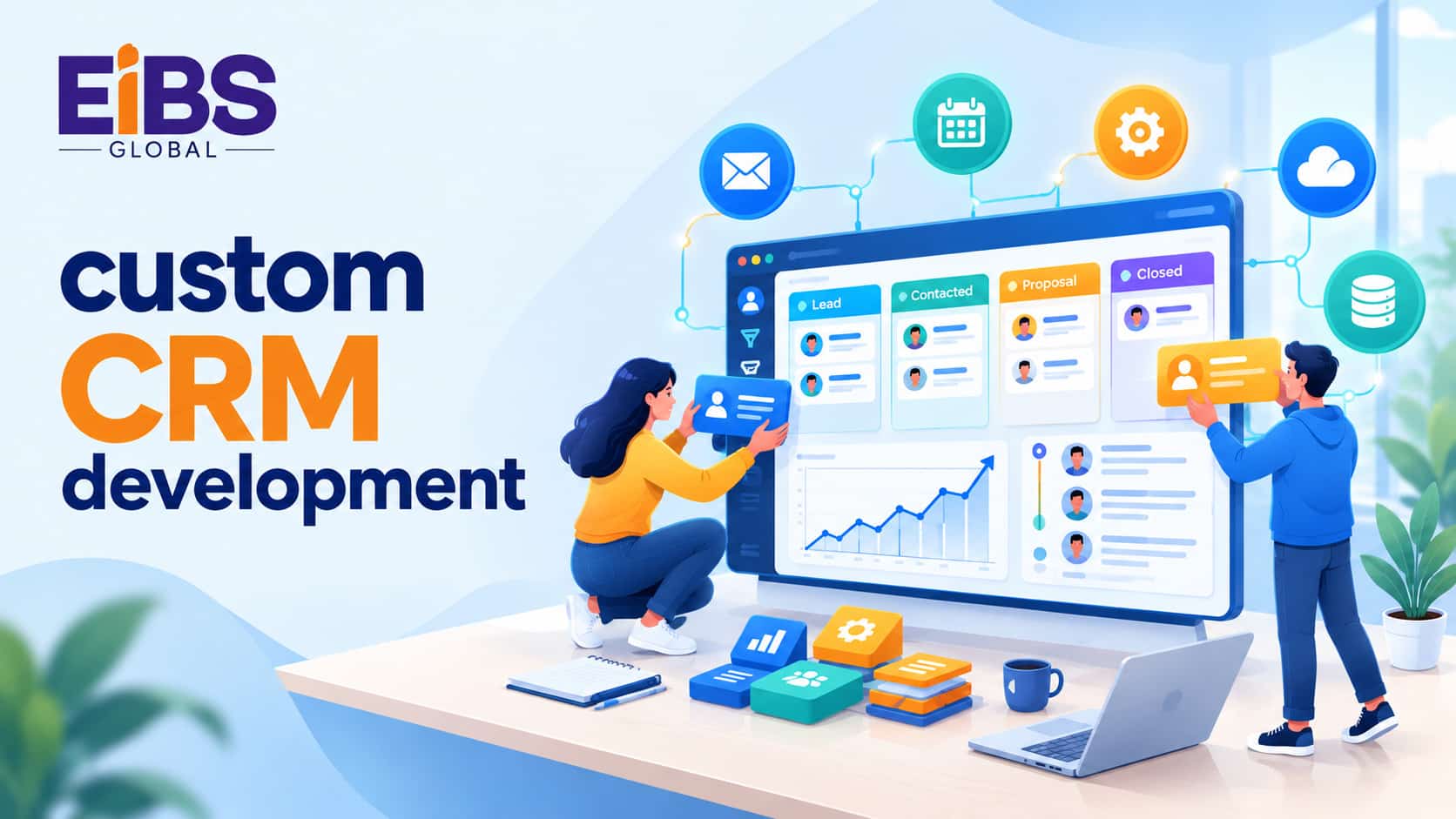
Introduction
Your sales team lives inside its CRM. Yet many teams spend more time fighting the tool than closing deals. Fields don’t match the sales process, reports need spreadsheet exports, and every new seat raises the bill. That is exactly why custom CRM development has moved from an enterprise luxury to a practical choice for growing companies.
In this guide, you will learn what a custom CRM is, when it beats off-the-shelf software, and what it really costs. We also walk through the 7-step build process and the mistakes that sink most projects. Along the way, we share lessons from CRM projects delivered by Elysian Intelligence Business Solution, so you can plan with real numbers rather than guesses.
What Is Custom CRM Development?
Custom CRM development is the design, build and deployment of a CRM platform made for one company’s processes, data and integrations. Unlike a packaged CRM, every screen, field and automation exists because your team needs it. As a result, users adopt it faster and admins maintain it more easily.
At a glance: custom CRM development
Definition: Building a CRM system from the ground up (or on a framework) around a company’s own workflows.
Best for: Teams with unique sales cycles, 50+ users, heavy integrations or strict compliance needs.
Typical cost: $40,000–$250,000+.
Typical timeline: 3–9 months to full release; 12–16 weeks to an MVP.
Key benefit: You own the code, the data and the roadmap.
Custom CRM vs CRM Customization
These two terms often get confused. CRM customization means configuring an existing product, such as adding fields in Salesforce or HubSpot. Custom CRM application development, by contrast, means building your own application. Customization is cheaper at first. However, it hits a ceiling when the vendor’s data model cannot match how you sell.
Why Do Businesses Choose Custom CRM Solutions?
Businesses choose custom CRM solutions when a packaged tool costs more to bend than to replace. The usual triggers are rising seat fees, workflows the vendor cannot model, and integrations that break with every update. In short, the CRM starts to shape the business instead of the other way round.
Demand reflects this shift. According to Grand View Research, the global CRM market was valued at about $65.6 billion in 2023 and is projected to grow at roughly 13.9% a year through 2030.
Your workflow doesn’t fit the template
Off-the-shelf CRMs assume a standard funnel: lead, opportunity, deal. Many businesses do not sell that way. For example, a logistics firm may quote per shipment lane, while a clinic tracks patients through referrals and follow-ups. A tailored build models these steps directly.
Licence costs grow with every seat
SaaS pricing scales per user, per month. Consequently, a 150-seat team on a premium tier can spend over $200,000 a year on licences alone. A custom system shifts that spend into an asset you own.
Integrations keep breaking
Most companies run an ERP, an accounting tool, a support desk and a marketing platform. Connecting them through third-party connectors adds cost and failure points. Bespoke CRM software development builds those integrations into the core.
Data ownership and compliance
Regulated industries need control over where data lives and who can see it. A custom CRM lets you host in your own region and enforce role-based access. It also helps you meet rules such as the EU General Data Protection Regulation (GDPR).
Custom CRM vs Off-the-Shelf CRM: Which Is Better?
Neither option is better for everyone. Off-the-shelf CRMs win on speed and low upfront cost. Custom CRM development wins on fit, long-term cost and control. The table below shows where each one comes out ahead.
| Factor | Off-the-Shelf CRM | Custom CRM |
|---|---|---|
| Upfront cost | Low ($0–$5,000 setup) | High ($40,000–$250,000+) |
| Ongoing cost | Per-seat fees rise with team size | Hosting + maintenance (15–20% of build per year) |
| Time to launch | Days to weeks | 3–9 months |
| Workflow fit | Standard funnels only | Built around your exact process |
| Integrations | Limited to marketplace apps | Any system with an API or database |
| Data ownership | Vendor-hosted | Fully owned; host anywhere |
| Scalability | Tied to pricing tiers | Scales with your infrastructure |
| Best for | Startups, under 20 users, simple sales | Growing teams, complex or regulated processes |
In practice, a hybrid path also exists. Some teams start on a SaaS tool, then move to a custom platform once they pass 50 users or hit integration limits.
What Features Should a Custom CRM Include?
A custom CRM should include only the features your team uses every week, plus the integrations that remove manual work. Start with a lean core, then add advanced modules once adoption is proven. This keeps the first release fast and affordable.
Core features (MVP)
- Contact and account management with a full activity timeline.
- Sales pipeline with drag-and-drop stages that mirror your real process.
- Task and reminder automation so follow-ups never slip.
- Role-based access control to protect sensitive records.
- Dashboards and reports your managers actually read.
- Email and calendar sync with Gmail or Microsoft 365.
Advanced features (Phase 2+)
- AI lead scoring that ranks prospects by likelihood to convert.
- Workflow builder for approvals, quotes and hand-offs.
- ERP, billing and support-desk integrations.
- Mobile app with offline access for field sales.
- Customer self-service portal for orders and tickets.
- Audit logs for compliance reviews.
How Does the Custom CRM Development Process Work?
The custom CRM development process runs in 7 steps: discovery, design, architecture, development, integration, testing and launch. Each step ends with a review, so you can change direction before costs pile up. Here is what happens at each stage.
- Discovery and requirements (2–4 weeks). Analysts interview sales, service and finance users. Then they map current workflows and rank must-have features.
- UX/UI design (2–3 weeks). Designers build clickable prototypes. Users test them before anyone writes code.
- Architecture and tech stack (1–2 weeks). Engineers choose the database, cloud host and framework. A common stack pairs React with Node.js or .NET and PostgreSQL.
- Agile development (8–20 weeks). The team ships working features in 2-week sprints. Meanwhile, stakeholders review each sprint demo.
- Integration (2–4 weeks). Developers connect the ERP, email, telephony and marketing tools through secure APIs.
- Testing and security (2–3 weeks). QA runs functional, load and security tests, including checks against the OWASP Top 10.
- Launch, training and support (ongoing). The team migrates data, trains users and monitors performance. Finally, a support plan covers fixes and new features.
How Much Does Custom CRM Development Cost?
Custom CRM development typically costs $40,000–$80,000 for an MVP, $80,000–$150,000 for a mid-market system, and $150,000–$250,000+ for an enterprise platform. The final price depends on the number of modules, integrations, user roles and compliance needs. Team location also matters, because hourly rates vary widely by region.
| Project tier | Scope | Typical cost (USD) | Timeline |
|---|---|---|---|
| MVP | Contacts, pipeline, tasks, basic reports, 1–2 integrations | $40,000–$80,000 | 12–16 weeks |
| Mid-market | MVP + workflow automation, email sync, 3–5 integrations, mobile web | $80,000–$150,000 | 4–6 months |
| Enterprise | Multi-team, AI scoring, ERP sync, audit logs, native mobile apps | $150,000–$250,000+ | 6–9 months |
Worked example: 3-year cost for a 120-user sales team
Numbers make the trade-off clear. Take a 120-user B2B team on a premium SaaS plan at $150 per user per month. Its licence bill is $216,000 a year, or $648,000 over three years.
Now compare a mid-market custom build. In this model from Elysian Intelligence Business Solution, the build costs $140,000. Maintenance runs at 18% of build cost ($25,200 a year), and cloud hosting adds $9,600 a year.
| Cost item | SaaS CRM (3 years) | Custom CRM (3 years) |
|---|---|---|
| Build / setup | $0 | $140,000 |
| Licences | $648,000 | $0 |
| Maintenance | Included | $75,600 |
| Hosting | Included | $28,800 |
| Total | $648,000 | $244,400 |
In this example, the custom system saves about $403,600 over three years and breaks even within year one. Of course, smaller teams may see a longer payback. Still, the wider business case for CRM is strong: Nucleus Research found that (CRM) returns an average of $8.71 for every dollar spent.
How Long Does It Take to Build a Custom CRM?
A custom CRM takes 3–9 months to build, depending on scope. A focused MVP can go live in 12–16 weeks. Enterprise platforms with many integrations usually need 6–9 months, plus a phased rollout across teams.
Three factors drive the timeline most. First, how quickly stakeholders sign off on requirements. Second, the number and quality of systems you need to integrate. Third, how clean your legacy data is before migration. Delays in any one of these push the launch date back.
How Do You Choose a Custom CRM Software Development Company?
Choose a custom CRM software development company that has shipped CRMs in your industry, shows its process openly, and offers support after launch. Ask for case studies, references and a sample sprint plan. Above all, check who owns the source code.
Use this checklist when you compare vendors for tailored CRM development services:
- Relevant portfolio. Look for at least 2–3 CRM projects of similar size.
- Discovery-first approach. Good partners insist on a paid discovery phase before quoting a fixed price.
- Security standards. Ask about encryption, access control and frameworks such as the NIST Cybersecurity Framework.
- Clear IP ownership. The contract should transfer full code ownership to you.
- Transparent pricing. Expect a line-item estimate, not a single lump sum.
- Post-launch support. Confirm response times, update cycles and an SLA.
What Are the Most Common Custom CRM Development Mistakes?
The most common custom CRM development mistakes are building too much too soon, skipping user input, and underestimating data migration. Each one adds months and cost. Fortunately, all of them are avoidable with good planning.
Conclusion: Is Custom CRM Development Right for You?
Custom CRM development makes sense when your process is unique, your team is growing, or your licence bill keeps climbing. It gives you a system that fits how you sell, connects every tool you use, and keeps your data under your control. On the other hand, small teams with simple pipelines may do fine with an off-the-shelf tool for now.
If you are weighing a build, start with a short discovery phase. It turns vague needs into a clear scope, cost and timeline. To get there faster, talk to the CRM team at Elysian Intelligence Business Solution for a free consultation and a project roadmap built around your workflow.