
Introduction
Every ERP vendor promises flexibility. Yet many businesses still end up bending their processes to fit the software, paying for workarounds, or watching license costs climb with every new hire. At some point, leaders ask a simple question: should we build our own?
Custom ERP software development services can answer that question well, or very badly. Built for the right reasons, a custom ERP becomes a lasting competitive asset. Built for the wrong ones, it becomes an expensive system only one team understands.
In this guide, Elysian Intelligence Business Solution gives a candid view of when custom makes sense, when it doesn’t, what it costs over five years, and how to stay in control of what you build.
What Are Custom ERP Software Development Services?
Custom ERP software development services are professional services that design, build, deploy, and support ERP software tailored to one organization’s processes, with the client owning the resulting code. They can cover a full custom system or custom modules built alongside a standard platform.
At a glance: Key terms Custom ERP software development builds new ERP functionality around your processes. ERP customization services change or extend an existing ERP platform. Tailored ERP solutions is the umbrella term for any ERP shaped to fit one business, whether built, customized, or both.
In practice, most “custom” projects are hybrids. For example, a company may keep a standard general ledger while building custom production, pricing, or service modules.
Custom ERP vs. ERP Customization: What’s the Difference?
Custom ERP means building new software you own, while ERP customization means changing an existing vendor platform. Between the two sit four levels of tailoring, each with different cost, flexibility, and upgrade risk.
| Level | What It Means | Flexibility | Upgrade Risk | Typical Use |
|---|---|---|---|---|
| 1. Configure | Use built-in settings, fields, and workflows | Low | Very low | Standard processes |
| 2. Customize | Modify platform code or scripts | Medium | High | Small gaps in vendor features |
| 3. Extend | Add apps or modules through APIs and SDKs | High | Low | Unique processes beside a standard core |
| 4. Build | Develop a full custom ERP or core modules | Very high | Owned by you | Processes no platform supports well |
As a rule, move up the scale only when the level below can’t meet the need. In addition, prefer level 3 over level 2, because extensions survive vendor upgrades far better than core code changes.
What Are the 5 Critical Signs You Need Custom ERP Software Development Services?
The five critical signs you need custom ERP software development services are core processes no platform supports, a competitive edge built on unique workflows, license costs that scale faster than value, heavy workarounds around current software, and integration needs a vendor can’t meet.
1. Your core processes don’t fit any platform
If every shortlisted ERP needs major changes to handle your core workflow, the fit problem is structural. For example, complex make-to-order configuration or unusual rental models often fall in this category.
2. Your process is your competitive advantage
When a pricing engine, scheduling method, or service model is why customers choose you, standard software can flatten that edge. A custom build protects it.
3. License costs grow faster than value
Per-user fees add up quickly for large or seasonal workforces. Consequently, owning the software can become cheaper than renting it over five years or more.
4. Workarounds have become the system
Spreadsheets, macros, and side databases around your ERP signal a poor fit. Moreover, they create hidden risk, because key logic lives outside any controlled system.
5. Integration needs exceed what vendors allow
If you need deep links with machines, partner systems, or your own products, vendor API limits may block you. In that case, ERP system integration services on a custom core give full control.
When Should You Not Build a Custom ERP?
You should not build a custom ERP when your processes are largely standard, your team can’t support software long term, or the main goal is simply to save money in year one. In these cases, configuring or extending a proven platform is usually smarter.
- Standard finance and distribution: Mature platforms already handle these well.
- No internal ownership: Without a product owner and a support plan, custom systems decay.
- Short time horizon: Custom ERP pays off over years, not months.
- Unclear requirements: If you can’t describe your process yet, start with discovery, not code.
- Strict regulatory accounting needs only: Certified platforms often reduce audit effort.
In short, custom ERP should solve a specific, lasting problem. Otherwise, it simply adds cost and responsibility.
What Should You Own at the End of the Project?
At the end of a custom ERP project, you should own the source code, architecture documentation, data model, deployment pipelines, test suites, and all administrator access. Full ownership is the main reason to choose custom, so it must be written into the contract.
Ownership checklist
- ☐ Source code in a repository your company controls
- ☐ Architecture and data-model documentation
- ☐ Automated tests and deployment pipelines
- ☐ Cloud accounts and environments in your name
- ☐ Admin credentials and security keys
- ☐ Licenses for any third-party components used
- ☐ A knowledge-transfer plan for your team or a new partner
With these in place, you can switch partners, bring work in-house, or scale the system without starting over.
How Do Custom ERP and SaaS ERP Compare Over Five Years?
Over five years, custom ERP usually costs more in years one and two but can cost less overall for large or growing teams, because there are no per-user license fees. SaaS ERP costs less upfront and shifts maintenance to the vendor, but its fees rise with headcount.
| Cost Item (250 users) | SaaS ERP | Custom ERP |
|---|---|---|
| Initial implementation or build | $300,000 | $900,000 |
| Licenses (5 years) | $1,800,000 ($120 per user / month) | $0 |
| Hosting and infrastructure (5 years) | Included | $300,000 |
| Maintenance and enhancements (5 years) | $250,000 | $810,000 (18% of build per year) |
| Five-year total | $2,350,000 | $2,010,000 |
Reading the numbers
In this example, custom ERP costs about $340,000 less over five years. However, it costs far more in year one, and the break-even depends heavily on user count. For instance, at 80 users the SaaS option would likely stay cheaper. Therefore, model your own headcount and growth before choosing custom ERP software development services on cost alone.
How Much Do Custom ERP Software Development Services Cost?
Custom ERP software development services typically cost $80,000 to $250,000 for custom modules beside a platform, $250,000 to $700,000 for a mid-sized custom ERP, and $700,000 or more for a full enterprise build. Ongoing maintenance usually adds 15–20% of the build cost each year.
| Scope | Typical Contents | Estimated Cost (USD) | Typical Timeline |
|---|---|---|---|
| Custom modules beside a platform | 1–3 modules via APIs, standard core | $80,000–$250,000 | 3–6 months |
| Mid-sized custom ERP | 4–7 modules, integrations, 50–300 users | $250,000–$700,000 | 8–14 months |
| Enterprise custom ERP | Multi-site, multi-entity, advanced logic | $700,000+ | 12–24 months |
In addition, include discovery ($15,000–$60,000), data migration, and change management in your budget. These are often left out of early estimates.
What Does a Successful Custom ERP Build Look Like?
A successful custom ERP build replaces workarounds with one owned system, launches in phases, and pays back within a few years. The worked example below shows a manufacturer with a process no standard platform handled well.
Worked example: a 320-person specialty packaging manufacturer
Consider a packaging manufacturer with 320 staff and two plants. Almost every order was custom-sized, with pricing based on material, print runs, and machine setup time. Its standard ERP couldn’t model this, so estimators used a 40-tab spreadsheet. As a result, quotes took up to two days, and margins varied widely.
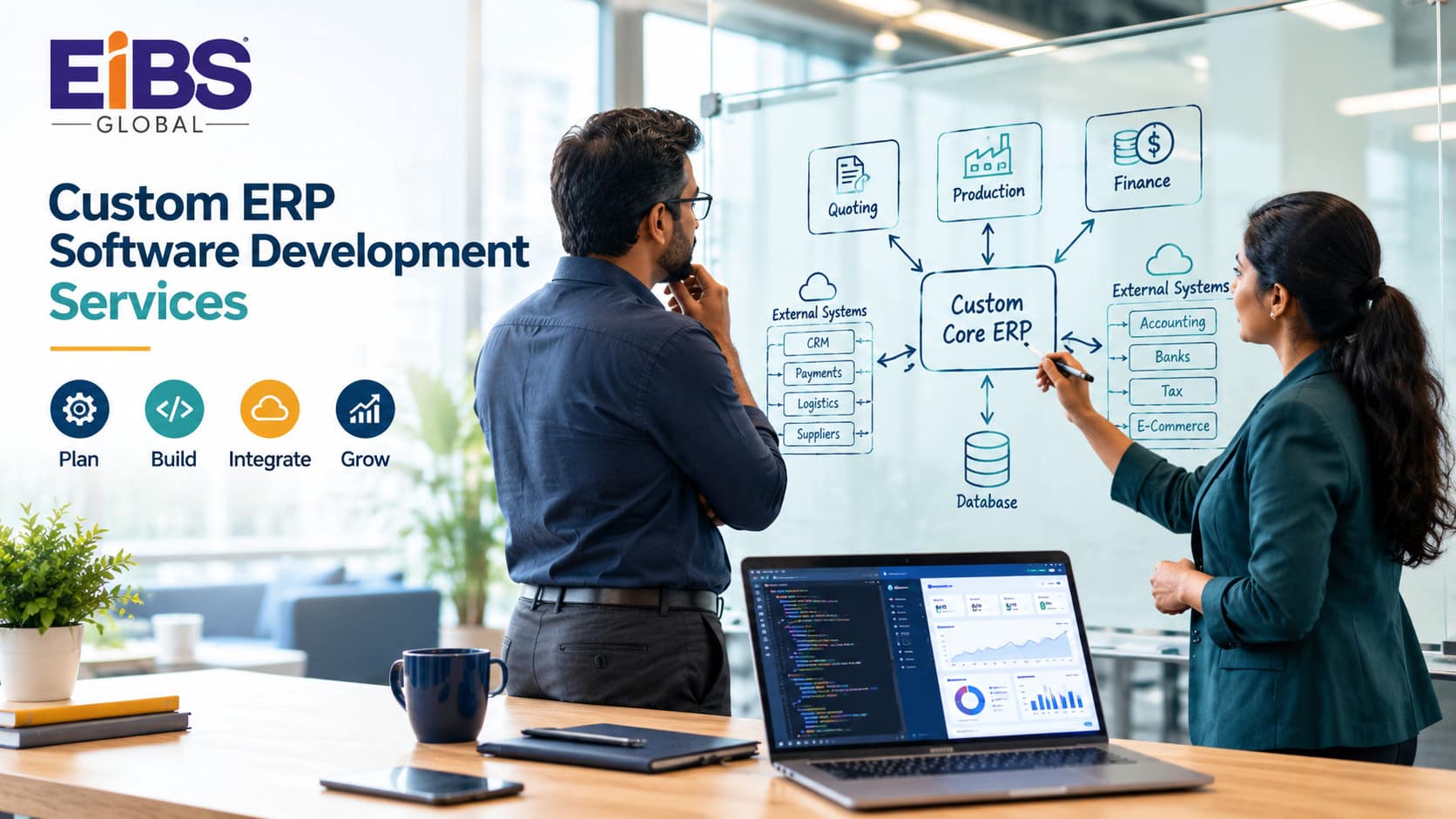
The company invested in custom ERP software development services after a six-week discovery. It kept its existing finance platform and built a custom core for quoting, production planning, and costing. Over eleven months, the partner:
- Built a rules-based quoting engine using real machine and material data.
- Created production scheduling linked to live machine capacity.
- Integrated the custom core with the finance platform through APIs.
- Delivered full source code, documentation, and test suites to the client’s repository.
One year after go-live, quote time fell from up to two days to about 20 minutes. In addition, margin variance across similar jobs dropped by roughly 60%, and the spreadsheet was retired. The build cost $610,000.
How Do You Reduce the Risks of Custom ERP Software Development Services?
You reduce the risks of custom ERP software development services by starting with paid discovery, delivering in phases, using modern modular architecture, enforcing documentation and testing, and securing full code ownership. Each control targets a common failure point.
| Risk | What Goes Wrong | How to Reduce It |
|---|---|---|
| Scope creep | The build keeps growing | Rank features; formal change control |
| Key-person dependency | Only one developer understands the code | Documentation, code reviews, shared ownership |
| Technical debt | Quick fixes pile up | Coding standards, automated tests, refactoring time |
| Vendor lock-in to the partner | You can't move the work | Code in your repository; knowledge transfer |
| Security gaps | Data exposed or breached | Secure design per NIST SSDF; regular testing |
| Low adoption | Users avoid the new system | User testing every sprint; role-based training |
At Elysian Intelligence Business Solution, for example, every custom build ships with a documented architecture and an automated test suite. Consequently, clients can maintain or extend the system with any qualified team.
Conclusion
Custom ERP software development services are a powerful choice when your processes are unique, valuable, and lasting. Check the five signs, rule out the cases where a platform fits better, and model five-year cost honestly. Then insist on full ownership and strong risk controls.
If you’re weighing build versus buy, Elysian Intelligence Business Solution can help. We offer custom ERP software development, ERP customization services, and ERP system integration services, with clear advice on which path fits. Get a free build-vs-buy review today.