Introduction
Most businesses don’t need an ERP built from scratch. They need a good platform shaped to fit how they work. Yet customization is where many ERP projects go wrong. Changes that look harmless in year one can block upgrades, slow the system, and lock you into one developer by year three.
That’s why choosing a customized ERP development company deserves as much care as choosing the software itself. The right partner tailors your ERP without trapping you. The wrong one leaves you with a fragile system nobody wants to touch.
In this guide, Elysian Intelligence Business Solution shares a practical vetting process. You’ll learn what upgrade-safe customization looks like, the 10 points to check, how to score partners side by side, and the red flags to avoid.
What Does a Customized ERP Development Company Do?
A customized ERP development company tailors an existing ERP platform to a business’s processes. Its work includes configuration, extension apps, custom modules, integrations, reports, and data migration, all designed to fit your workflows while keeping the platform supported and upgradable.
At a glance: Customization vs. custom build ERP system customization adapts a vendor platform, such as Dynamics 365, NetSuite, SAP Business One, or Odoo, to your needs. Custom ERP development services can also mean building a system from scratch. A customization partner focuses on the first: getting the most from a proven platform without breaking it.
In practice, these partners sit between the software vendor and your team. They translate business needs into platform changes, and they’re responsible for making those changes safe.
Why Does the Right Customization Partner Matter?
The right customization partner matters because poor customization creates technical debt that blocks upgrades, raises support costs, and makes the ERP harder to use over time. Good customization, by contrast, adds value that lasts through many vendor releases.
What goes wrong with poor customization
- Blocked upgrades: Core code changes break when the vendor releases updates.
- Rising support costs: Every fix takes longer because the logic is tangled.
- Partner lock-in: Only the original developer understands the changes.
- Slower performance: Inefficient custom code drags down the whole system.
- Audit risk: Undocumented changes to finance logic worry auditors.
In fact, many “failed ERP” stories are really stories of over-customization. Therefore, the way a partner customizes is as important as what it builds.
What Makes ERP Customization Upgrade-Safe?
Upgrade-safe ERP customization uses built-in configuration first, adds features through supported extensions and APIs, avoids changing core platform code, and keeps every change documented, tested, and version-controlled. These principles let you take vendor updates without rework.
- Configure before you customize. Use standard settings, workflows, and fields wherever possible.
- Extend, don’t modify. Build features as extensions or apps that sit beside the core.
- Integrate through APIs. Connect other systems through supported interfaces, not direct database writes.
- Keep changes small and modular. Separate customizations so each can be updated alone.
- Version-control everything. Store all code and configuration in a repository you own.
- Automate testing. Run regression tests before every vendor upgrade.
- Document as you go. Record what each change does and why it exists.
For example, Microsoft’s guidance for Dynamics 365 Business Central recommends building on extensions rather than changing base code, which is a good benchmark for any platform.
What Are the 10 Points to Check When Hiring a Customized ERP Development Company?
The 10 points to check when hiring a customized ERP development company are platform certification, upgrade-safe methods, industry experience, live references, team depth, integration skills, data migration approach, testing practices, documentation standards, and support terms. Together, they show whether a partner can customize well and safely.
- Platform certification: Verified partner status and certified consultants on your ERP.
- Upgrade-safe methods: A clear policy of configure first, extend second, and avoid core changes.
- Industry experience: At least two similar projects in your sector.
- Live references: Clients you can call who have since taken vendor upgrades.
- Team depth: Enough developers and consultants to avoid key-person risk.
- Integration skills: Proven API, middleware, and ERP system customization work.
- Data migration approach: A tested method for cleaning and loading data.
- Testing practices: Automated regression tests and user-acceptance testing.
- Documentation standards: Technical and functional documents you’ll receive.
- Support terms: SLAs, upgrade support, and handover commitments.
Above all, give extra weight to point 4. A reference who has survived two or three upgrades tells you more than any sales presentation.
How Do You Score and Compare Partners?
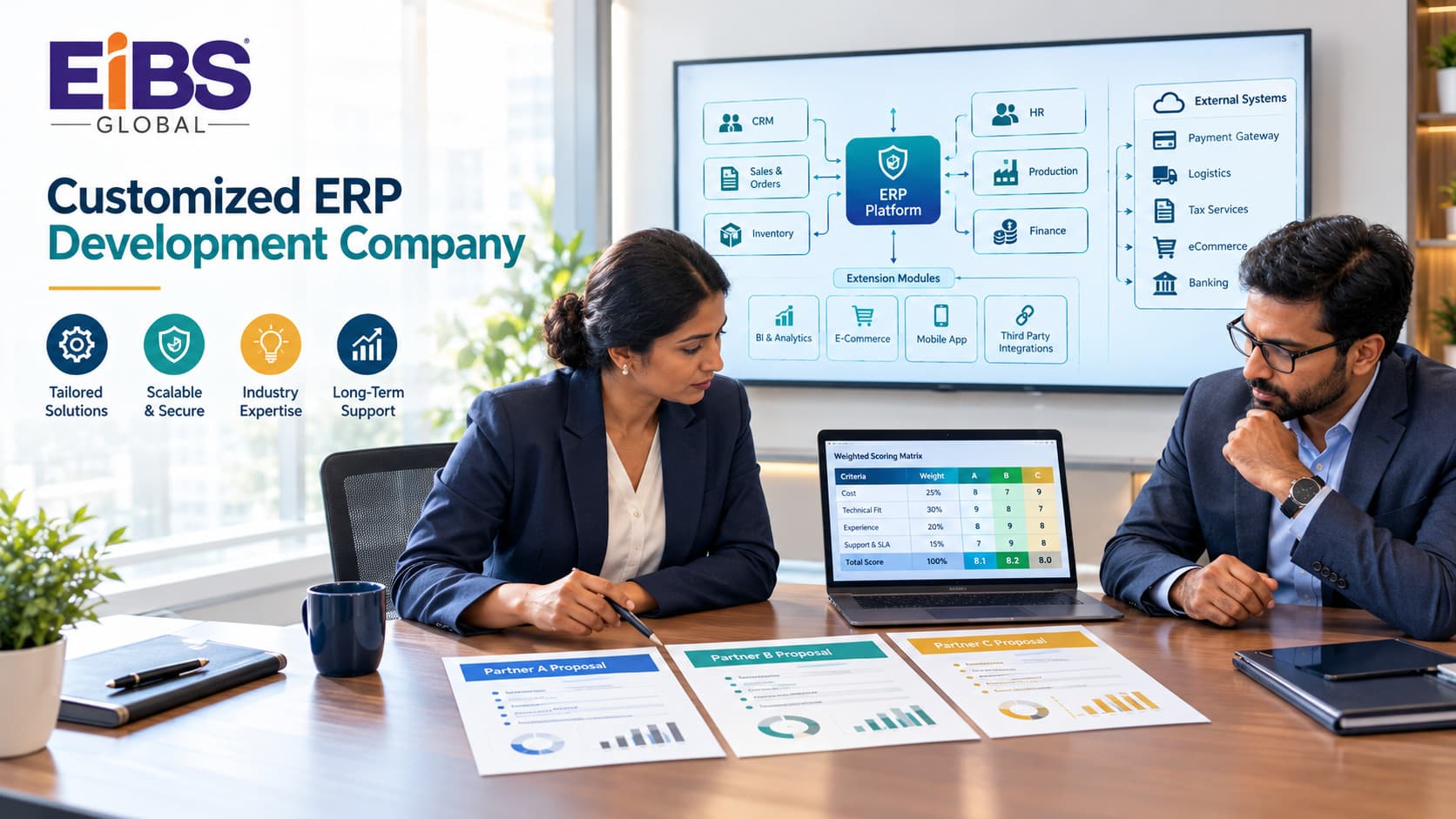
Score partners with a weighted matrix: assign each criterion a weight, rate every firm from 1 to 5, then multiply and add the results. This turns subjective impressions into a clear, comparable total.
| Criterion | Weight | Firm A | Firm B | Firm C |
|---|---|---|---|---|
| Platform and customization expertise | 25% | 5 | 4 | 3 |
| Upgrade-safe practices | 20% | 4 | 5 | 2 |
| Industry experience | 15% | 3 | 4 | 5 |
| Delivery and governance | 15% | 4 | 4 | 3 |
| Support and SLA | 10% | 4 | 3 | 4 |
| Cost | 10% | 3 | 4 | 5 |
| Communication and fit | 5% | 4 | 3 | 5 |
| Weighted total (out of 5) | 100% | 4.00 | 4.05 | 3.50 |
What the scores show
In this example, Firm C has the best price and deepest industry experience. However, its weak upgrade-safe practices pull its total to 3.50. Meanwhile, Firm B wins narrowly, because it combines strong upgrade discipline with solid all-round scores. Consequently, the cheapest bid isn’t the best long-term choice.
What Should You Ask in Your RFP?
Your RFP should ask each customized ERP development company to explain its customization approach, show upgrade history, name the delivery team, and detail testing, documentation, and support. Specific questions produce answers you can actually compare.
Customization approach
- What share of our requirements can you meet with configuration alone?
- Which items need extensions, and which, if any, need core changes? Why?
- How do you decide when not to customize?
Upgrade history
- Which clients on our platform have upgraded after your work, and how long did it take?
- What broke during those upgrades, and how did you fix it?
Team and delivery
- Who will work on our project, and what certifications do they hold?
- How much of the work is subcontracted or offshore?
Testing, documentation, and support
- What automated tests will you deliver with the customizations?
- What documentation will we receive, and in what format?
- What do your SLAs cover after go-live and after each vendor upgrade?
At Elysian Intelligence Business Solution, for example, every proposal includes a configuration-versus-customization breakdown for each requirement. As a result, clients can see exactly where custom work is, and isn’t, needed.
How Much Does a Customized ERP Development Company Charge?
A customized ERP development company typically charges $90 to $200 per hour, or $30,000 to $400,000 per project, depending on platform, scope, and integrations. Ongoing support often costs $2,000 to $15,000 per month, and upgrade support may be priced separately.
| Engagement | Typical Scope | Estimated Cost (USD) |
|---|---|---|
| Customization audit | Review existing changes and upgrade readiness | $10,000–$40,000 |
| Targeted customization | 3–5 extensions, reports, and workflows | $30,000–$120,000 |
| Full tailoring project | Industry modules, integrations, data migration | $120,000–$400,000 |
| Ongoing support | Fixes, small changes, user help | $2,000–$15,000 per month |
| Upgrade support | Regression testing and fixes per vendor release | $5,000–$40,000 per upgrade |
In addition, ask whether quotes include automated tests and documentation. If they don’t, the true long-term cost will be higher.
What Does a Successful Customization Project Look Like?
A successful customization project meets business needs with the fewest possible core changes and leaves the ERP easy to upgrade. The worked example below shows a company recovering from earlier over-customization.
Worked example: a 260-person food distributor
Consider a food distributor with 260 staff and three warehouses. A previous partner had made over 140 direct code changes to its ERP. As a result, the company had skipped four vendor upgrades, and each attempted update broke pricing and lot tracking.
It hired a new customized ERP development company, which began with a four-week customization audit. Over seven months, the partner:
- Removed 58 changes that standard features now covered.
- Rebuilt pricing and lot-tracking logic as 12 supported extensions.
- Moved three direct database integrations to the platform’s APIs.
- Added an automated regression test suite and full documentation.
Afterward, the company caught up on all four upgrades in a single phased release. Moreover, the next vendor upgrade took four days instead of an estimated six weeks, and support tickets fell by about 45%. The project cost $265,000.
Note: This is an illustrative composite example based on typical mid-market outcomes. Replace it with a verified Elysian client case study before publishing.
Red Flags When Choosing a Customized ERP Development Company
The biggest red flags when choosing a customized ERP development company are a willingness to change core code freely, no upgrade references, vague documentation promises, and quotes far below competitors. Each one points to future cost and risk.
- “We can change anything.” Unlimited core changes usually mean upgrade problems later.
- No upgrade references. If no client has upgraded after their work, ask why.
- No automated testing. Manual testing alone can’t keep pace with vendor releases.
- Vague documentation. “We’ll document as needed” often means not at all.
- One-person dependency. A single developer holding all the knowledge is a major risk.
- Suspiciously low quotes. They often leave out testing, documentation, or data work.
Conclusion
The right customized ERP development company tailors your ERP without trapping you. Insist on upgrade-safe methods, use the 10-point checklist, score partners with a weighted matrix, and ask RFP questions that reveal how each firm really works. Then put documentation, testing, and code ownership in the contract.
If you’d like a partner that customizes for the long term, Elysian Intelligence Business Solution can help. We provide ERP system customization, ERP implementation services, and customized ERP software solutions built to survive every upgrade. Start today with a free customization review.