
Introduction
By the time a shortlist reaches the CTO’s desk, every vendor looks capable. The case studies are polished, the slides are confident, and the hourly rates are within range. Yet the ERP system you buy will run your finance and operations for a decade or more. So the real question is simple: can this team actually engineer it well?
That’s where technical due diligence comes in. Choosing an ERP system development company should involve the same scrutiny you’d apply to an acquisition: look at the architecture, the code, the security posture, and the people.
In this guide, Elysian Intelligence Business Solution shares a technical checklist for IT leaders. You’ll learn the nine areas to examine, how delivery models compare, what a strong SLA includes, and which red flags should end the conversation.
What Does an ERP System Development Company Do?
An ERP system development company designs, engineers, integrates, and supports enterprise resource planning software, either as a full custom system or as major modules on an existing platform. Its core work is technical: architecture, data models, code, integrations, security, and operations.
At a glance: Who does what
- An ERP implementation company mainly configures and rolls out an existing platform.
- An ERP system development company writes and maintains significant custom code and architecture.
- An ERP solutions provider may do either, plus consulting and licensing.
This guide focuses on the second type, where engineering quality matters most.
Why Does Technical Due Diligence Matter for ERP Systems?
Technical due diligence matters because ERP systems are long-lived, deeply connected, and hold sensitive financial data. Weak architecture or poor security practices are expensive to fix after go-live and can expose the business to outages, audit findings, or data breaches.
- Longevity: ERP systems often run for 10 years or more, so early design choices compound.
- Integration depth: One weak interface can disrupt finance, inventory, and sales at once.
- Data sensitivity: ERP holds payroll, pricing, customer, and supplier data.
- Switching cost: Changing partners mid-project is slow and costly.
Therefore, a few days of structured review before signing can save months of rework later.
What Are the 9 Critical Tech Checks for an ERP System Development Company?
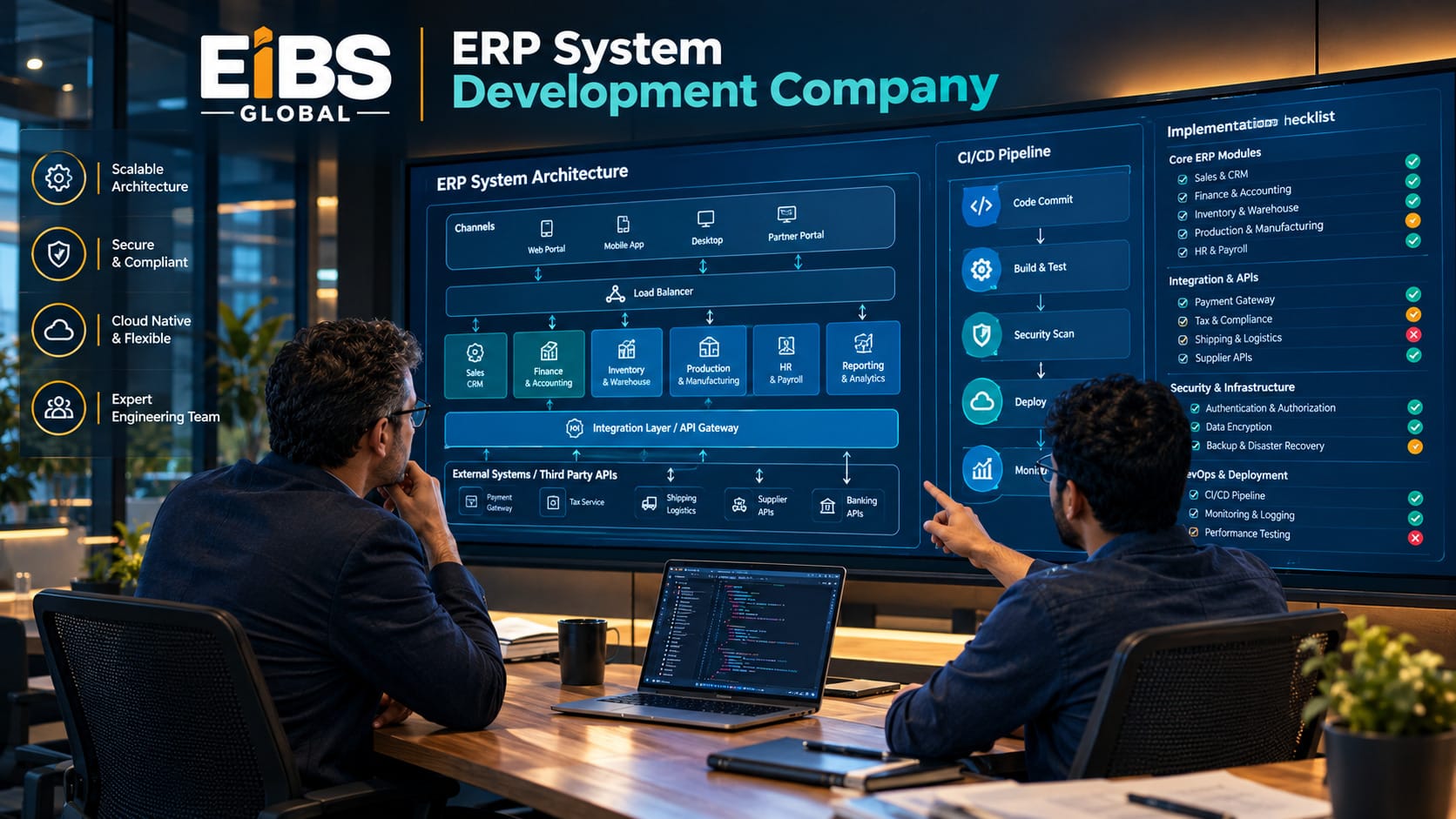
The nine critical tech checks for an ERP system development company are architecture, code quality, security and certifications, data and migration, integration, DevOps, performance and scalability, support and SLAs, and team continuity. For each, ask for evidence rather than descriptions.
Architecture
Ask for a reference architecture from a similar project. Look for modular design, clear service boundaries, and API-first thinking. In addition, check how they handle multi-entity and multi-currency needs.
Code quality
Request an anonymized code sample or a supervised walkthrough. Check naming, structure, comments, and test coverage. Ask which static-analysis tools they run on every build.
Security and certifications
Ask for current certificates, such as ISO/IEC 27001 or a SOC 2 Type II report. Also review their secure development process, ideally aligned with the NIST Secure Software Development Framework.
Data and migration
Ask how they profile, clean, map, and reconcile legacy data. Strong firms run several trial migrations with automated reconciliation reports.
Integration
Review their integration patterns: APIs, middleware, events, and file-based exchange. Check error handling, retries, and monitoring.
DevOps maturity
Look for version control, automated builds, automated tests, separate environments, and repeatable deployments. Ask how long a typical release takes from code to production.
Performance and scalability
Ask for load-test results from past projects. Check how the system scales with users, transactions, and data volume.
Support and SLAs
Review their sample SLA, incident process, and monitoring tools. Confirm who responds out of hours.
Team continuity
Ask about staff turnover, documentation standards, and how knowledge transfers when people leave. Named key roles should be written into the contract.
Onshore, Nearshore, or Offshore: Which Delivery Model Fits?
Onshore teams offer the closest collaboration at the highest cost, offshore teams offer the lowest cost with less time-zone overlap, and nearshore sits in between. Many ERP projects use a blended model: onshore leadership with nearshore or offshore engineering.
| Factor | Onshore | Nearshore | Offshore |
|---|---|---|---|
| Typical cost | Highest | Medium | Lowest |
| Time-zone overlap | Full | Most of the day | Limited |
| Workshops in person | Easy | Occasional | Rare |
| Cultural and language fit | Closest | Usually close | Varies |
| Talent pool size | Limited | Medium | Large |
| Best for | Discovery, design, regulated work | Ongoing development with daily contact | Large build phases with clear specs |
In practice, keep architecture, discovery, and user workshops close to the business. Meanwhile, well-specified development and testing can run further away without hurting quality.
What Should an ERP Support SLA Include?
An ERP support SLA should define severity levels, response and resolution targets, support hours, escalation paths, uptime commitments, reporting, and service credits. Clear terms turn “we’ll support you” into measurable promises.
| Severity | Example | Response Target | Resolution or Workaround Target |
|---|---|---|---|
| Critical (P1) | System down, invoicing stopped | 30 minutes, 24/7 | 4 hours |
| High (P2) | Key process failing, workaround exists | 2 business hours | 1 business day |
| Medium (P3) | Minor function broken | 1 business day | 5 business days |
| Low (P4) | Cosmetic issue or question | 2 business days | Next release |
In addition, the SLA should cover monthly reporting, root-cause analysis for P1 incidents, and service credits when targets are missed.
How Much Does an ERP System Development Company Charge?
An ERP system development company typically charges $120 to $220 per hour onshore in North America or Western Europe, $55 to $110 nearshore, and $30 to $70 offshore. Blended teams often land between $60 and $120 per hour. Full projects range from about $150,000 to well over $1 million.
| Role | Onshore (USD/hour) | Nearshore (USD/hour) | Offshore (USD/hour) |
|---|---|---|---|
| Solution architect | $170–$250 | $90–$140 | $55–$90 |
| Senior developer | $130–$200 | $65–$110 | $35–$70 |
| Business analyst | $110–$180 | $55–$95 | $30–$60 |
| QA engineer | $90–$150 | $45–$80 | $25–$50 |
| Project manager | $120–$190 | $60–$100 | $35–$65 |
However, the lowest rate rarely gives the lowest total cost. A team that needs more rework, more management, or more time can quickly erase the hourly savings. Therefore, compare estimated total hours and quality evidence, not rates alone.
What Does Technical Due Diligence Look Like in Practice?
In practice, technical due diligence takes two to four weeks and compares shortlisted firms against the same evidence requests. The worked example below shows how one manufacturer used the nine checks to choose an ERP system development company.
Worked example: a 450-person precision-parts manufacturer
Consider a precision-parts manufacturer with 450 staff, three plants, and a legacy ERP nearing end of support. It shortlisted three firms with similar prices and case studies. The IT director then ran a three-week technical review using the nine checks.
| Check | Firm A | Firm B | Firm C |
|---|---|---|---|
| Architecture | Pass | Pass | Pass |
| Code quality | Partial (low test coverage) | Pass | Pass |
| Security and certifications | Pass | Fail (ISO certificate expired) | Pass |
| Data and migration | Pass | Pass | Pass |
| Integration | Pass | Partial | Pass |
| DevOps | Fail (manual deployments) | Pass | Pass |
| Performance | Partial (no load tests) | Pass | Pass |
| Support and SLA | Pass | Pass | Partial (no 24/7 P1 cover) |
| Team continuity | Pass | Partial | Pass |
Firm C passed eight of nine checks, and its only gap, 24/7 critical support, was fixed in the contract. As a result, the manufacturer chose Firm C. The review itself cost about $18,000 in internal time and an external architect’s fees.
Twelve months after go-live, the new system had 99.9% uptime and no critical incidents in the first six months. Moreover, releases moved from quarterly to every two weeks, thanks to the automated pipeline confirmed during due diligence.
Red Flags When Hiring an ERP System Development Company
The biggest red flags when hiring an ERP system development company are refusing to share technical evidence, missing or expired security certifications, manual deployments, no load testing, and vague support terms. Any one of these deserves a hard follow-up question.
- “Our code is confidential.” A walkthrough under NDA should always be possible.
- Expired or missing certificates. Ask for current audit reports, not old logos.
- Manual deployments. They signal slow releases and higher error risk.
- No load-test evidence. Performance problems often appear only at month-end or peak season.
- Unnamed team. If key people aren’t named, they may change after signing.
- SLA without service credits. Targets without consequences are only suggestions.
At Elysian Intelligence Business Solution, for example, we share architecture samples, test reports, and our sample SLA during evaluation. That way, technical buyers can verify claims before any commitment.
Conclusion
Choosing an ERP system development company is an engineering decision as much as a commercial one. Run the nine tech checks, ask for evidence at every step, choose a delivery model that matches your risk, and lock service levels into the contract. A few weeks of due diligence protects a system you’ll rely on for years.
If you’d like a partner that welcomes technical scrutiny, Elysian Intelligence Business Solution can help. Our ERP system development services cover architecture, custom ERP system development, integration, and SLA-backed support. Start now with a free technical review.