The world of technology is evolving at an unprecedented pace, and software development trends are at the center of this transformation. In 2026, software is no longer just about writing code; it is about building intelligent systems that can learn, adapt, and scale with business needs. From artificial intelligence to cloud computing modern development practices are reshaping how applications are designed, developed, and delivered across industries
Businesses today rely heavily on digital solutions to stay competitive. As a result, understanding the latest trends in software development has become essential for Software development company that want to innovate faster, improve efficiency, and deliver better user experiences. Whether it is startups launching new products or enterprises modernizing legacy systems, staying updated with current trends in software industry is the key to long-term success
One of the biggest shifts in the industry is the move toward automation and intelligence. Technologies like AI-driven development, edge computing, and low-code platforms are enabling faster development cycles while reducing operational complexity. At the same time security and scalability have become critical as applications handle more sensitive data and serve global users
Another important factor shaping the future of software development technologies is the growing demand for personalized and real-time experiences. Users expect applications to be fast responsive and tailored to their needs, which is pushing developers to adopt new software development technologies that can deliver high performance and seamless interactions
In this rapidly changing environment businesses must not only adopt emerging technologies in software development but also align them with their strategic goals. The ability to leverage trending technologies in software development will determine how effectively companies can innovate reduce costs and create value for their customers
As we explore the top software development trends in this guide you will gain a clear understanding of how these innovations are transforming the industry and what they mean for the future of software development.
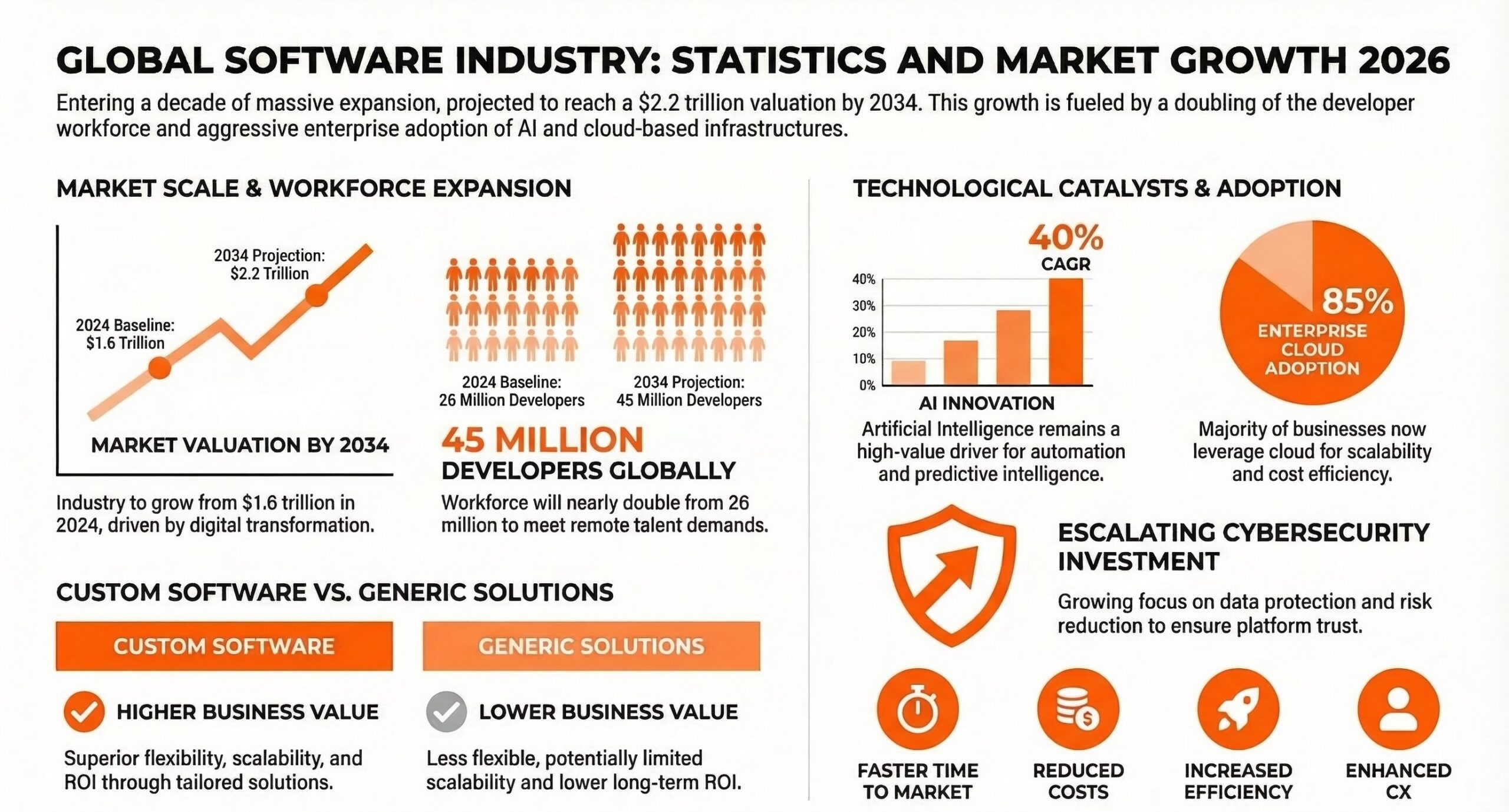
Global Software Industry Statistics and Market Growth 2026
The global software industry is not just expanding it is creating real business value by transforming how organizations operate compete and grow. Understanding software development trends through statistics is not about numbers alone it is about identifying opportunities improving efficiency and making smarter investment decisions
Top Software Development Trends Shaping 2026
The top software development trends of 2026 include AI-first development, low-code platforms, cloud-native architectures, edge computing, and cybersecurity integration, transforming how applications are built and deployed. These trends accelerate innovation, enhance efficiency, and enable businesses to stay competitive and future-ready.
Shift Toward Intelligent and Automated Systems
The modern software landscape is rapidly evolving toward intelligent systems that can learn adapt and improve over time. Powered by advancements in Artificial Intelligence applications are no longer static but dynamic and data driven. Automation is reducing manual effort while enabling faster and more accurate decision making making it a core part of new software development technologies
Increasing Demand for Speed and Agility
Speed has become a critical factor in software success. Businesses are expected to launch products quickly and respond to market changes in real time. This has led to the adoption of agile development DevOps practices and low-code platforms, which significantly reduce development cycles while maintaining quality and performance
Focus on Scalability and Performance
As digital platforms grow, applications must handle large volumes of users and data efficiently. This is why scalability is a key component of current trends in the software industry. Cloud-native architectures and microservices enable businesses to build flexible systems that can scale without performance issues
Security as a Core Development Priority
With increasing cyber threats, security is no longer an afterthought. Modern development integrates security at every stage of the lifecycle, ensuring that applications are protected from vulnerabilities. This approach builds trust and ensures long-term reliability for businesses and users
User Experience as a Competitive Advantage
User expectations are higher than ever. Applications must be fast, responsive, and personalized to meet user needs. Businesses are focusing on user-centric design to improve engagement, satisfaction, and retention, making experience a key factor in latest trends in software development
Integration of Multiple Technologies
One of the most important emerging software development technologies is the integration of different systems into a unified ecosystem. Combining AI cloud computing and IoT enables businesses to create smarter connected solutions that deliver higher value and efficiency
Evolution Toward Intelligent and Scalable Ecosystems
Overall the top software development trends in 2026 highlight a clear shift toward intelligent, scalable, secure, and user-focused systems. Organizations that adopt these trends can improve efficiency reduce operational costs and build innovative solutions that stand out in the competitive digital market
AI-First Software Development and Agentic AI
AI-first software development leverages agentic AI and autonomous tools to design, code, test, and optimize applications with minimal human intervention. This approach accelerates development cycles, reduces errors, and enables smarter, more adaptive software solutions.
What is AI-First Software Development
AI-first software development is no longer about adding AI to existing applications. Instead, AI becomes the starting point of software design, influencing architecture, workflows, and functionality. This approach allows software to be inherently intelligent, adaptive, and capable of automating complex processes from the ground up.
By designing AI into the core, businesses can leverage technologies such as deep learning, speech recognition, and computer vision to create applications that continuously learn, improve, and deliver personalized experiences.
Rise of Agentic AI and Autonomous Applications
Agentic AI refers to systems designed to act autonomously to achieve complex goals rather than just executing predefined commands. These AI “agents” can write code, test software, detect bugs, and even make decisions in workflows, reducing human intervention and speeding up the development cycle.
Autonomous apps powered by agentic AI are transforming industries by enabling:
-
Self-optimizing business workflows
-
Automated data analysis for decision-making
-
Intelligent predictive systems in real time
Generative AI and Large Language Models (LLMs)
Generative AI and LLMs are becoming central to software development. They assist in:
-
Code generation and debugging
-
Automated documentation
-
Designing software architectures
-
Enhancing content creation within applications
Specialized on-device AI models are emerging to increase efficiency and reduce dependency on cloud-based computations, making applications faster and more secure.
Real-World Applications and Case Studies
Healthcare: AI analyzes medical records, lab results, and genetic data to foresee diseases and suggest effective treatments.
Manufacturing: AI predicts machinery failures and improves production efficiency using IoT data.
Agriculture: AI-powered systems detect plant diseases and identify weeds for optimized farming.
Case Study: ScienceSoft developed an AI-based application for brain MRI scans that uses convolutional neural networks (CNNs) to localize tumors, plan surgeries, and track treatment progress, showcasing AI-first software in action.
Business Value of AI-First Development
AI-first software enables businesses to:
-
Make smarter, data-driven decisions
-
Reduce manual workload and human error
-
Improve operational efficiency and speed to market
-
Deliver highly personalized and intelligent user experiences
Emerging Technologies in Software Development
Emerging technologies in software development, including hyperautomation, quantum computing, AI-native tools, and immersive AR/VR, are redefining how applications are built and deployed. These innovations drive efficiency, scalability, and smarter business solutions for the future-ready enterprise.
Deep Learning and Machine Learning Advancements
Deep learning and machine learning continue to drive innovation in the software industry. These technologies enable systems to analyze vast amounts of data, recognize patterns, and make predictions that help businesses optimize operations. From recommendation engines in ecommerce to predictive maintenance in manufacturing, machine learning has become a core component of modern applications.
Computer Vision and Image Recognition
Computer vision allows software to interpret and understand visual data. Applications include:
-
Automated quality control in manufacturing
-
Facial recognition for security and personalization
-
Medical imaging for diagnostics
This emerging technology is transforming industries by enabling faster and more accurate decision-making based on visual insights.
Speech Recognition and Natural Language Processing (NLP)
Speech recognition and NLP are powering voice-enabled interfaces, chatbots, and virtual assistants. These tools enhance user experience by enabling conversational interactions with software, making applications more intuitive and accessible. Businesses leverage these technologies to provide real-time support, automate workflows, and improve engagement.
Predictive Analytics for Business Decisions
Predictive analytics uses AI and machine learning algorithms to forecast trends, detect anomalies, and guide strategic decisions. It is widely applied in:
-
Finance for fraud detection and risk management
-
Healthcare for patient outcome prediction
-
Retail for inventory and sales forecasting
By integrating predictive analytics, businesses gain actionable insights that reduce risk and optimize performance.
Integration of AI with Emerging Hardware
Emerging software development technologies are increasingly combined with IoT devices, edge computing, and high-speed networks. This integration enables:
-
Real-time data processing at the edge
-
Smart connected devices that adapt to user behavior
-
Faster and more efficient automation in operations
Business Value of Emerging Technologies
Adopting emerging technologies in software development provides businesses with:
-
Improved operational efficiency
-
Smarter decision-making capabilities
-
Enhanced customer engagement through intelligent applications
-
Competitive advantage through innovation
These technologies form the foundation for next-generation software systems that are not only faster and more capable but also more intelligent and adaptive to evolving business needs.
Cloud-Native Development and Serverless Architecture
Cloud-native development and serverless architecture enable businesses to build scalable, cost-efficient, and highly reliable applications without managing infrastructure. These approaches accelerate deployment, improve flexibility, and support global, real-time operations.
What is Cloud-Native Development
Cloud-native development is a modern approach to building and running applications that fully leverage cloud computing capabilities. Instead of deploying software on traditional servers, cloud-native applications use scalable, distributed infrastructure that adapts to demand. This approach enables businesses to deliver software faster while ensuring high availability and performance.
Serverless Architecture Explained
Serverless architecture allows developers to build and run applications without managing underlying servers. Instead, cloud providers automatically handle infrastructure, scaling, and maintenance. Benefits include:
-
Faster deployment of applications
-
Automatic scaling based on traffic
-
Reduced operational complexity and costs
Serverless computing empowers developers to focus on writing code and delivering features rather than worrying about server maintenance.
Microservices and Containerization
Modern cloud-native applications often use microservices architecture, breaking down large applications into smaller, independent services. Containers (e.g., Docker) package these services with their dependencies, making deployment consistent and efficient.
Key advantages:
-
Easy scalability of individual services
-
Faster updates and bug fixes
-
Improved fault isolation for more reliable systems
Business Value of Cloud-Native and Serverless
Cloud-native and serverless approaches deliver measurable business benefits:
-
Cost Efficiency: Pay only for resources used
-
Faster Time to Market: Accelerate product releases and updates
-
Scalability: Handle growing user demands seamlessly
-
Resilience: Minimize downtime and improve reliability
By adopting cloud-native development and serverless architecture, organizations can build high-performing, scalable, and flexible software systems that align with the latest software development trends.
Edge Computing and Real-Time Data Processing
Edge computing brings data processing closer to devices, enabling real-time, low-latency applications across industries like IoT, healthcare, and autonomous systems. This approach reduces bandwidth costs, enhances reliability, and supports faster decision-making.
Understanding Edge Computing
Edge computing is a technology approach where data processing happens closer to the source—on devices, sensors, or local servers—instead of sending all data to a centralized cloud. This reduces latency, ensures faster response times, and supports applications that require real-time decision-making.
Importance for Real-Time Applications
Industries like healthcare, autonomous vehicles, manufacturing, and IoT rely on instantaneous data processing. By analyzing data at the edge, businesses can:
-
Respond immediately to critical events
-
Reduce dependency on network bandwidth
-
Improve reliability for mission-critical applications
Integration with AI and IoT
Edge computing becomes even more powerful when combined with AI and IoT:
-
AI at the Edge: Smart devices can analyze data locally to detect anomalies, optimize processes, or trigger automated actions
-
IoT Devices: Sensors and connected devices generate massive volumes of data that need quick processing for actionable insights
-
This integration enables intelligent and autonomous systems that operate efficiently without relying on central servers
Business Value of Edge Computing
Adopting edge computing delivers measurable benefits for organizations:
-
Low Latency: Immediate responses improve user experience and operational efficiency
-
Cost Optimization: Reduces cloud processing and storage costs
-
Reliability: Local processing ensures continuity even with network disruptions
-
Enhanced Security: Sensitive data can be processed locally, reducing exposure
Applications Across Industries
-
Healthcare: Real-time monitoring of patient vitals and alerting
-
Automotive: Autonomous vehicles making split-second decisions
-
Manufacturing: Predictive maintenance and automated quality control
-
Retail: Personalized recommendations in real-time at point-of-sale
By leveraging edge computing, businesses can create faster, smarter, and more resilient software solutions, staying ahead of competitors in the era of AI-first and real-time applications.
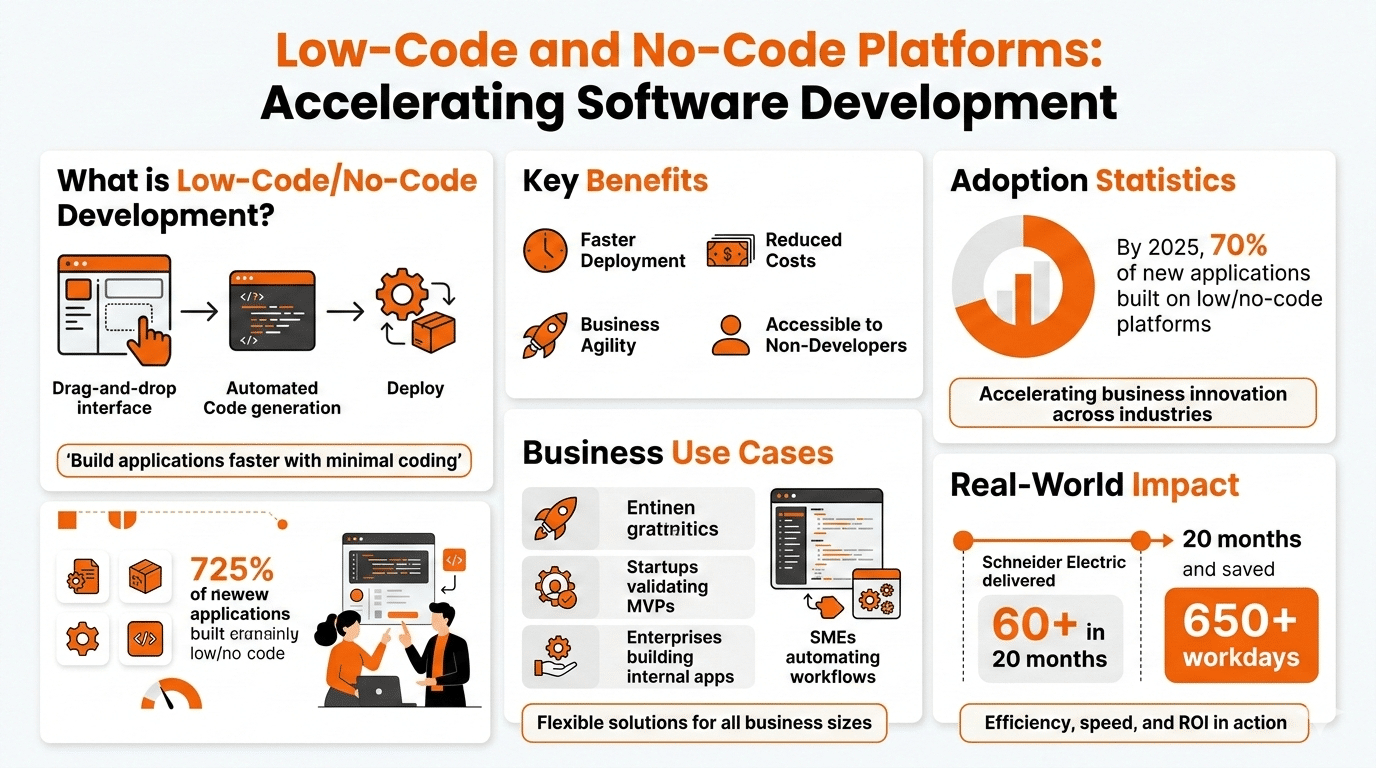
Low-Code and No-Code Platforms : Accelerating Software Development
Low-code and no-code platforms empower businesses and startups to rapidly build applications without deep coding expertise, reducing development time and costs. These platforms enable faster MVP validation, streamline innovation, and democratize software creation.
Blockchain Beyond the Financial Sector
Blockchain is a decentralized digital ledger that securely records transactions across multiple systems, making data transparent, immutable, and tamper-proof. While it originally gained popularity in finance, blockchain is now being adopted across industries such as supply chain, healthcare, manufacturing, and public services.
Its core benefits include encrypted data storage, automated contract execution, and full traceability of transactions, which are transforming traditional business processes into smarter, more secure operations.
Key Advantages of Blockchain for Businesses
-
Data Safety: Decentralized storage prevents fraud and unauthorized access. Each transaction is encrypted and recorded across all nodes, reducing the risk of tampering.
-
Smart Contracts: Contracts are automatically executed when pre-defined conditions are met, eliminating manual errors and ensuring trust.
-
Transparency: Blockchain provides real-time visibility into transactions, improving accountability and reducing the need for intermediaries.
Real-World Applications
Supply Chain & Logistics:
-
Walmart used blockchain to trace food provenance. By asking suppliers to upload data to the distributed ledger, mangoes could be traced back to the origin farm in just 2.2 seconds versus 7 days manually.
Healthcare:
-
Medical records can be stored securely and shared only with authorized stakeholders, ensuring both privacy and accessibility.
Manufacturing:
-
IoT devices can feed operational data into blockchain networks, allowing real-time monitoring and predictive maintenance.
Business Value of Blockchain
Implementing blockchain beyond finance provides measurable benefits for organizations:
-
Faster Operations: Streamlined processes and automated contract execution reduce delays.
-
Enhanced Security: Immutable ledgers protect sensitive information from tampering.
-
Cost Efficiency: Reduces reliance on intermediaries and manual verification.
-
Trust & Transparency: Builds confidence with customers, partners, and regulators.
Blockchain is no longer a niche financial technology—it has become a strategic tool for organizations seeking secure, efficient, and transparent digital solutions across industries.
Progressive Web Apps (PWAs) and Cross-Platform Development
Progressive Web Apps and cross-platform development enable businesses to deliver fast, reliable, and engaging user experiences across devices without building separate native apps. These technologies reduce development costs, accelerate market entry, and increase user accessibility.
What Are Progressive Web Apps (PWAs)?
Progressive Web Apps are web applications that behave like mobile apps but don’t require downloading from app stores. They combine the reach of the web with the speed, reliability, and engagement of native apps, offering a seamless experience across devices.
PWAs are becoming a crucial part of software development trends because they reduce development time, improve performance, and increase accessibility for users.
Key Benefits of PWAs
-
Smooth User Experience:
-
PWAs load 2–3 times faster than traditional web pages
-
Work offline and handle high server loads without crashing
-
-
Cost and Time Efficiency:
-
One PWA serves multiple platforms, reducing the need for separate Android and iOS apps
-
Lower development and maintenance costs compared to native apps
-
-
Improved Engagement:
-
Push notifications and app-like features enhance user interaction
-
Longer session durations and higher retention rates
-
Cross-Platform Development
Cross-platform development complements PWAs by allowing one codebase to run on multiple operating systems. This reduces development efforts and ensures consistent performance across platforms.
Key technologies supporting cross-platform development include:
-
React Native
-
Flutter
-
Xamarin
Real-World Case Study
Forbes PWA:
-
Mobile load time reduced from 6.5 seconds to 2.5 seconds
-
User session length doubled, showing improved engagement
-
Highlights how PWAs enhance speed, user experience, and retention
Business Value of PWAs and Cross-Platform Apps
Adopting PWAs and cross-platform solutions provides businesses with:
-
Faster time to market for apps and updates
-
Reduced development and maintenance costs
-
Improved user satisfaction and engagement
-
Scalability for reaching broader audiences across devices
PWAs and cross-platform development are key strategies for businesses aiming to provide a seamless, cost-effective, and high-performing digital experience in 2026 and beyond
DevSecOps and Cybersecurity Integration
DevSecOps integrates security into every stage of software development, ensuring applications are secure, compliant, and resilient against threats. This approach reduces risks, automates threat detection, and builds trust in digital solutions.
What is DevSecOps?
DevSecOps is the integration of security practices directly into the DevOps workflow rather than treating security as a separate final step. It ensures that applications are secure by design, with continuous monitoring and automated security checks throughout development, testing, and deployment.
This approach aligns with the latest software development trends, emphasizing speed, agility, and security simultaneously.
Importance of Cybersecurity in Modern Development
With the rise in cyber threats, embedding security early in the development lifecycle is critical. DevSecOps helps organizations:
-
Detect vulnerabilities before deployment
-
Automate threat detection and remediation
-
Reduce the risk of costly security breaches
-
Maintain compliance with regulations
Key Practices in DevSecOps
-
Continuous Security Testing: Automated tools scan code for vulnerabilities at every stage
-
Shift-Left Approach: Security is implemented from the early phases of development
-
Threat Modeling: Identifying potential threats and designing countermeasures proactively
-
Security as Code: Embedding security rules and policies directly into infrastructure and pipelines
Business Value of DevSecOps
Integrating DevSecOps provides tangible benefits:
-
Faster Release Cycles: Security checks do not delay deployment
-
Reduced Risk: Early detection of vulnerabilities minimizes potential damages
-
Cost Savings: Prevents expensive post-deployment fixes and breaches
-
Improved Trust: Builds confidence with clients and users through secure applications
Emerging Trends in Cybersecurity for 2026
-
AI-Powered Threat Detection: Predict and neutralize threats in real time
-
Zero Trust Security Models: Authenticate all users and devices continuously
-
Cloud Security Integration: Secure cloud-native and serverless applications
-
Automated Compliance: Tools ensure adherence to industry standards like GDPR and HIPAA
By adopting DevSecOps, organizations can deliver secure, high-quality applications faster, keeping pace with the growing complexity of modern software systems.
Future Trends and Emerging Software Development Technologies
The future of software development is shaped by hyperautomation, quantum computing, immersive AR/VR, AI-first tools, and edge computing, driving smarter and faster digital solutions. These emerging technologies empower businesses to stay innovative, secure, and scalable in an increasingly competitive landscape.
AI-Native Development and Autonomous Systems
The future of software industry is increasingly AI-first, with AI embedded directly into applications rather than added later. Autonomous systems, powered by agentic AI, will write, test, and optimize code independently, enabling faster innovation and reducing human intervention.
Businesses will leverage AI-native platforms for:
-
Intelligent decision-making
-
Automated software testing
-
Personalized user experiences
Quantum Computing for Complex Problem Solving
Quantum computing is transitioning from theoretical research to practical applications in areas like:
-
Logistics optimization
-
Financial modeling
-
Material science and simulations
This technology promises unprecedented processing power, solving problems conventional computing cannot handle efficiently.
Hyperautomation and Intelligent Process Automation
Hyperautomation combines AI, machine learning, and Robotic Process Automation (RPA) to automate complex workflows beyond repetitive tasks. Businesses will see:
-
Reduced operational costs
-
Increased accuracy in processes
-
Faster execution of enterprise-level operations
5G-Advanced, 6G, and Edge Connectivity
High-speed networks like 5G and upcoming 6G will drive:
-
Real-time IoT applications
-
Autonomous vehicles
-
Immersive AR/VR experiences
Edge computing will complement these networks by processing data closer to the source, reducing latency and improving performance.
Blockchain and Decentralized Applications
Beyond finance, blockchain will enable secure, transparent, and automated operations in:
-
Supply chain management
-
Healthcare record-keeping
-
Smart contracts for automated workflows
Businesses will adopt decentralized solutions to enhance trust, security, and traceability.
Low-Code/No-Code Evolution
Low-code and no-code platforms will continue to democratize software development, enabling non-technical users to build applications while accelerating innovation.
By 2026 and beyond, these platforms will support AI integrations, microservices, and enterprise-scale applications, helping organizations respond quickly to market demands.
Sustainability and Ethical Technology
Software development will increasingly consider green computing and ethical AI:
-
Reducing carbon footprints of applications and infrastructure
-
Ensuring AI systems are transparent, fair, and unbiased
-
Aligning technology development with corporate social responsibility
Top Software Development Technologies in 2026
In 2026, software development is driven by AI-native tools, edge computing, low-code platforms, and cloud-native architectures, transforming how applications are built, secured, and deployed. These technologies accelerate development, enhance efficiency, and enable smarter, scalable, and future-ready solutions.
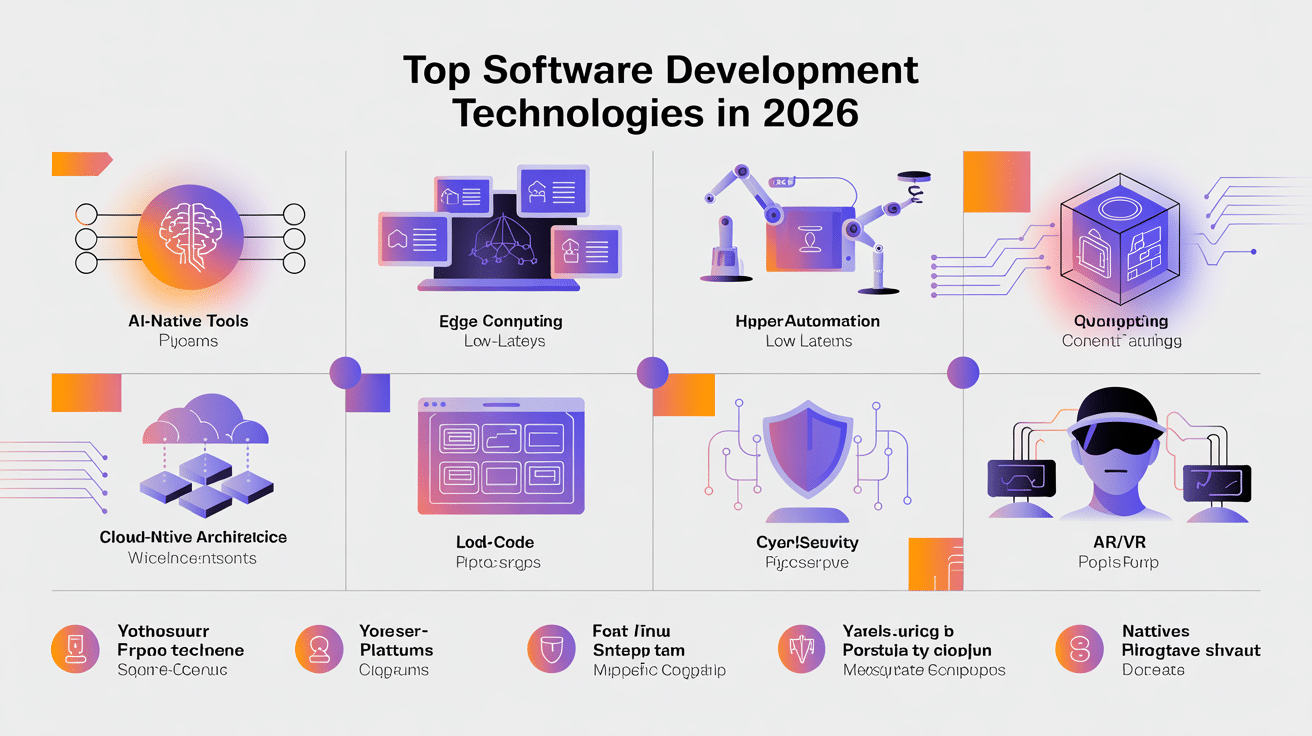
AI-Native and Generative AI Tools
AI is no longer just an assistant—it is becoming the core of software development. AI-native platforms and generative AI tools are now capable of:
-
Writing, testing, and debugging code autonomously
-
Designing software architectures
-
Generating content and documentation
These tools accelerate development cycles and reduce human error, making AI the most trending technology for software development in 2026.
Edge Computing and AI at the Edge
Processing data closer to devices rather than central servers allows real-time, low-latency applications. Key advantages include:
-
Faster decision-making
-
Reduced bandwidth costs
-
Enhanced reliability and security
Edge computing is essential for industries like autonomous vehicles, IoT, and healthcare.
Hyperautomation and RPA Integration
Hyperautomation combines AI, machine learning, and Robotic Process Automation (RPA) to automate complex business workflows beyond repetitive tasks. Businesses achieve:
-
Reduced operational costs
-
Increased accuracy and compliance
-
Faster and smarter execution of processes
Quantum Computing
Quantum computing is moving from research labs to real-world applications, solving problems traditional computers struggle with, such as:
-
Complex logistics optimization
-
Financial modeling and simulations
-
Advanced material science calculations
This emerging technology is shaping the future of software industry.
Cloud-Native & Serverless Architecture
Cloud-native applications leverage microservices, containerization, and serverless computing to ensure scalable, cost-efficient, and reliable software solutions. Benefits include:
-
Faster deployment
-
Lower infrastructure management overhead
-
High scalability for global operations
Low-Code / No-Code Platforms
These platforms democratize software development, enabling business users and startups to create applications quickly without deep coding expertise. Advantages include:
-
Accelerated MVP validation
-
Reduced development costs
-
Enhanced innovation for enterprises
Cybersecurity & DevSecOps
Security is integrated into every stage of software development, ensuring secure and reliable applications. Techniques include:
-
Continuous threat monitoring
-
Automated compliance
-
Zero Trust security models
Immersive and Spatial Computing (AR/VR)
AR/VR technologies are expanding beyond gaming into:
-
Remote collaboration
-
Training and simulation
-
E-commerce and marketing experiences
These technologies enhance user engagement and open new business opportunities.
The software development industry in 2026 is rapidly evolving, driven by AI-first approaches, low-code/no-code platforms, cloud-native architectures, and real-time edge computing. Emerging technologies like quantum computing, immersive AR/VR, blockchain, and hyperautomation are reshaping how applications are designed, deployed, and experienced.
At Elysian Intelligence Business Solutions, we help businesses leverage these trends to create innovative, secure, and scalable software solutions that deliver measurable results. By adopting AI-first, secure, and scalable strategies, software development company can stay ahead of the competition, enhance user experiences, and drive long-term growth.
With the right technology approach, software development becomes a powerful engine for innovation, efficiency, and business success.